
Sundance Film Festival 2026
To every builder, partner, artist, volunteer, donor, moderator, and attendee — thank you.
Solidarity House did not emerge overnight. The foundation was laid a few months earlier during conversations at Beyond the Screen, OTV’s 10th Anniversary Convening in Chicago, where a small group of leaders from several organizations began discussing the growing pressures within the independent film ecosystem — consolidation, reduced access to capital, and increasing fragmentation across the field. Those early conversations surfaced a shared interest in creating a more collaborative, values-aligned gathering space during the 2026 Sundance Film Festival.
The organizations represented in those initial discussions would later become the early builders of Solidarity House. Importantly, when we began planning, there was no assumption that this initiative would extend beyond Sundance. The intention was to design a responsive, time-bound container that could meet the moment — offering shared space for dialogue, connection, and alignment during a critical time in the industry. There was no long-term roadmap attached. The goal was to test whether coalition-driven infrastructure could function inside a high-stakes festival environment.
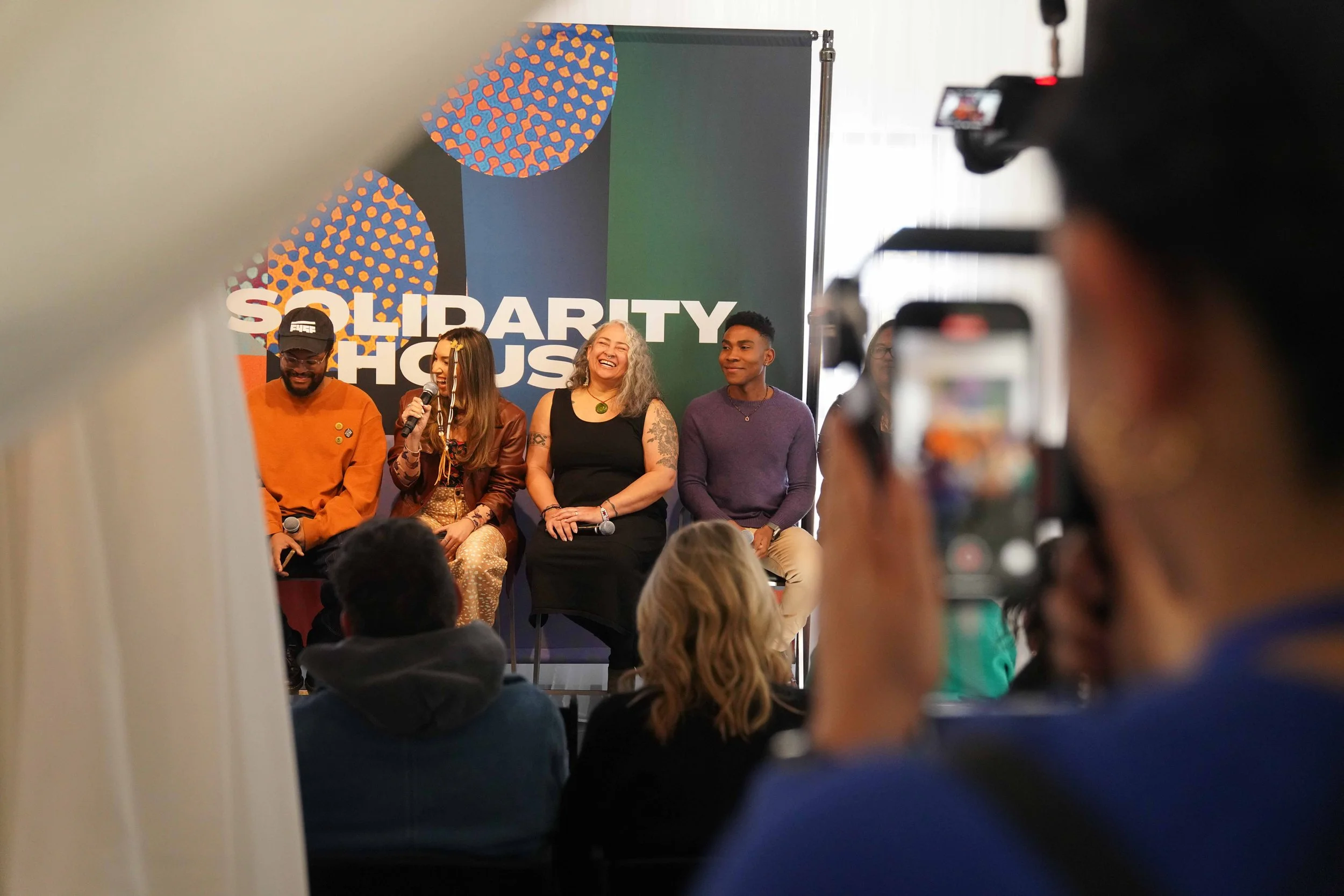
Over three days in Park City, that experiment proved both viable and necessary. Solidarity House was built in real time through cross-organizational collaboration, shared fundraising, volunteer labor, and collective stewardship. In a festival ecosystem that can often feel competitive and exclusionary, we intentionally designed an accessible and community-centered space for artists, funders, distributors, and field leaders to gather.
The result was not only strong attendance and highly engaged programming, but also the emergence of new partnerships, deeper trust across organizations, and a growing appetite for shared infrastructure.
We are deeply grateful to everyone who contributed to making this possible.
WHAT WE ACCOMPLISHED
Governance & Stewardship
Solidarity House at the Sundance Film Festival 2026 was stewarded by a coalition of more than 50 organizations and field leaders committed to reimagining how we gather, resource, and support independent storytelling. This was not a single-host activation or a sponsored pop-up. It was collectively led and collectively held.
At the center of this effort was a volunteer Builder Group — leaders who contributed their time, labor, networks, and strategic thinking to ensure three days of programming anchored in care and access. This was not a contracted production team; it was field leadership stepping forward to test what shared infrastructure could look like in practice. The builder structure we inherited — and intentionally formalized — allowed us to move with clarity and shared accountability, distributing responsibility rather than centralizing it within one institution.
The core Builder Group included BLIS Collective, Brown Girls Doc Mafia, Open Television, New America, Seed&Spark, Center for Cultural Power, and Transgender Film Center, organizing alongside dozens of additional coalition members.
To ensure distributed leadership and operational clarity, builders worked across three committees: Vision & Strategy; Programming & Audience Engagement; and Production & Outreach. Coalition members hosted and moderated conversations, activated their communities, participated in fundraising efforts, supported production logistics, and volunteered on-site. The result was a coordinated, values-driven activation shaped by collective stewardship — a shared container designed, resourced, and sustained together.
Commitments
The Solidarity House Commitments became the organizing backbone of this activation. Developed by the Builder Group in the early stages of planning, these commitments were not symbolic — they were operational. They informed how we structured the space, how we made decisions, and how we oriented ourselves with partners throughout the festival.
Through these commitments, coalition members affirmed a shared set of values rooted in:
Care over competition
Transparency over gatekeeping
Collaboration over extraction
Access over exclusivity
Abundance over scarcity
Every coalition member participating in Solidarity House was required to formally sign on to these commitments. In addition, partners completed a partnership intake form that allowed us to gather ecosystem-level data about the independent media landscape — including organizational focus areas, artist support models, geographic reach, and resource needs. This process helped ensure values alignment while also generating a clearer snapshot of the ecosystem we are collectively working to strengthen.
For many participating organizations, signing the commitments marked a shift from informal collaboration to intentional coalition. It established shared expectations for conduct, accountability, and mutual support — and laid the groundwork for how we might continue to work together beyond a single festival moment.
Programming & Curatorial Framework
Solidarity House programming was built collaboratively. Session ideas, speakers, and moderators were sourced directly from coalition members to ensure the agenda reflected the breadth and complexity of the independent media ecosystem. Rather than curating in isolation, the Builder Group leveraged collective networks and expertise to shape a program rooted in shared values.
To ensure transparency and equitable representation, we collectively agreed upon a clear curatorial framework. The guiding theme, “Imagination as Infrastructure,” positioned the space as both practical and aspirational — a forum where cultural leaders, artists, and organizers could engage in substantive dialogue about the urgent challenges facing independent storytelling. The focus was not simply conversation, but alignment: building solidarity, strengthening relationships, and reinforcing the infrastructure our field requires.
To operationalize this framework, we established the following parameters:
Every panel included at least one filmmaker, maker, or storyteller.
Each session featured at least two organizations from the Solidarity House network (builders, collaborators, or amplifiers).
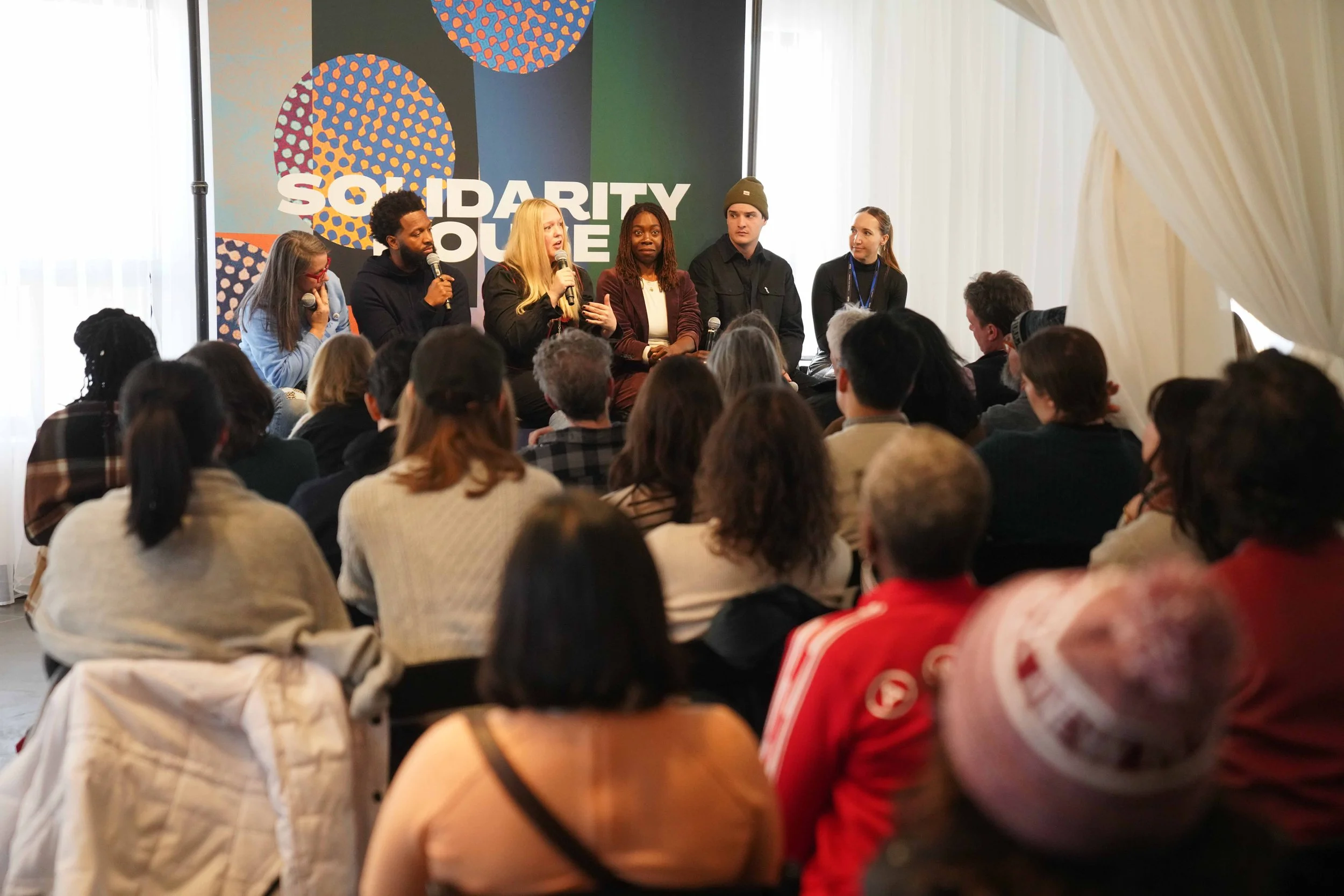
All sessions were moderated by prepared, skilled facilitators.
No panel exceeded six participants (including moderator).
Conversations were intentionally tied back to solidarity and ecosystem infrastructure.
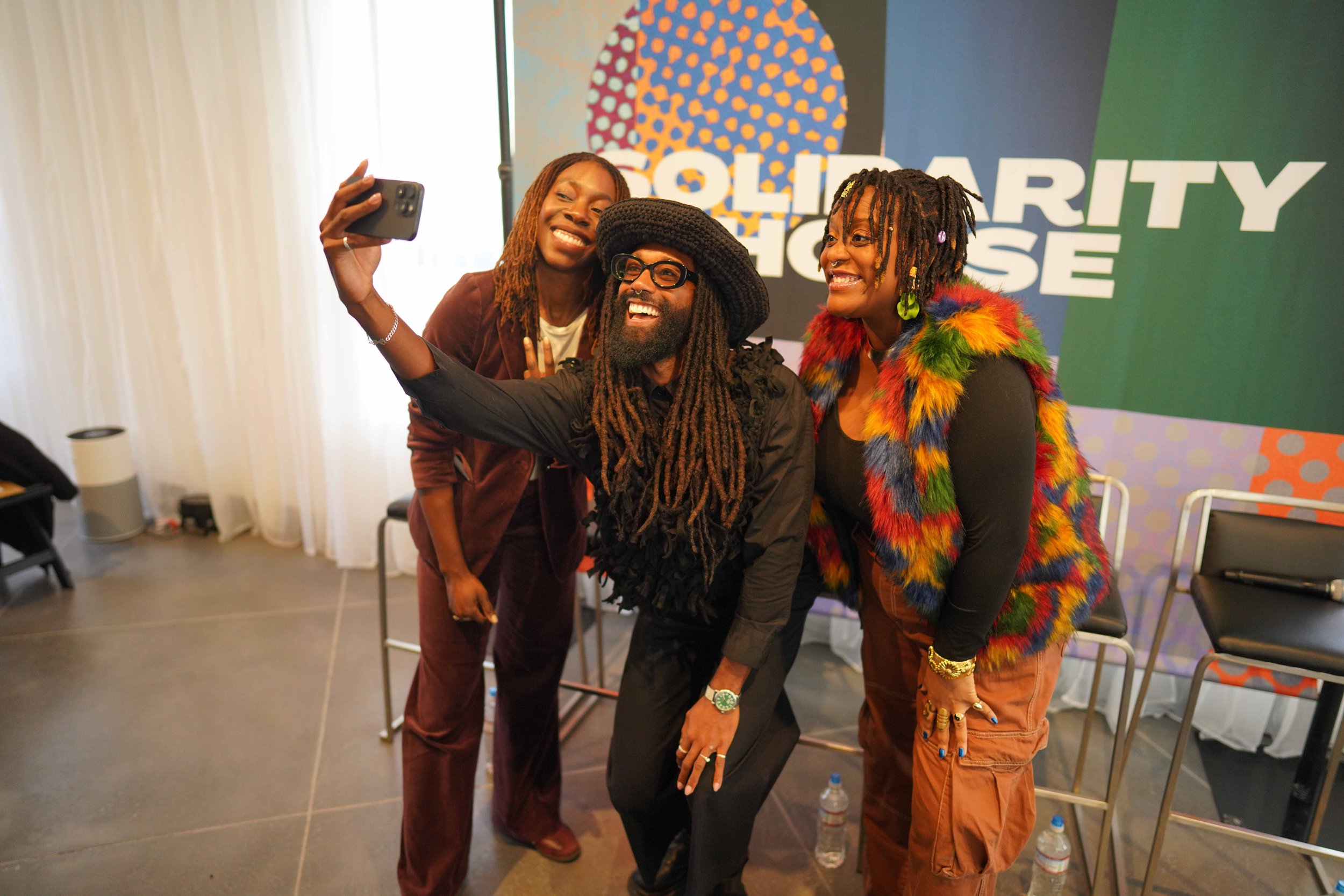
Over three days, Solidarity House hosted panel discussions, community mixers, coalition meetings, cross-organizational activations, anniversary celebrations, informal strategy sessions, and funders in dialogue with artists. Across sessions, conversations were candid, solutions-oriented, and grounded in both accountability and imagination.
Attendance, Access, Wellness & Protection
From the outset, Solidarity House was designed with intention around access, wellness, and protection. At a festival known for exclusivity, long lines, and high barriers to entry, we prioritized permeability and care. Every activation was free and accessible via digital RSVP, allowing us to manage capacity thoughtfully, support accessibility needs, and maintain a welcoming, regulated flow throughout the weekend.
This infrastructure was deliberate. It helped us avoid overcrowding, anticipate audience flow, and create an environment grounded in safety, clarity, and relational accountability rather than urgency.
Across 13 free, RSVP-based activations, we welcomed an estimated ~1,560 attendee-visits (total entries across all sessions). Accounting for repeat participation across multiple events, we estimate this represents approximately ~900–1,100 unique individuals engaging with Solidarity House over three days.
Programming included:
8 panels
2 Liberation Labs
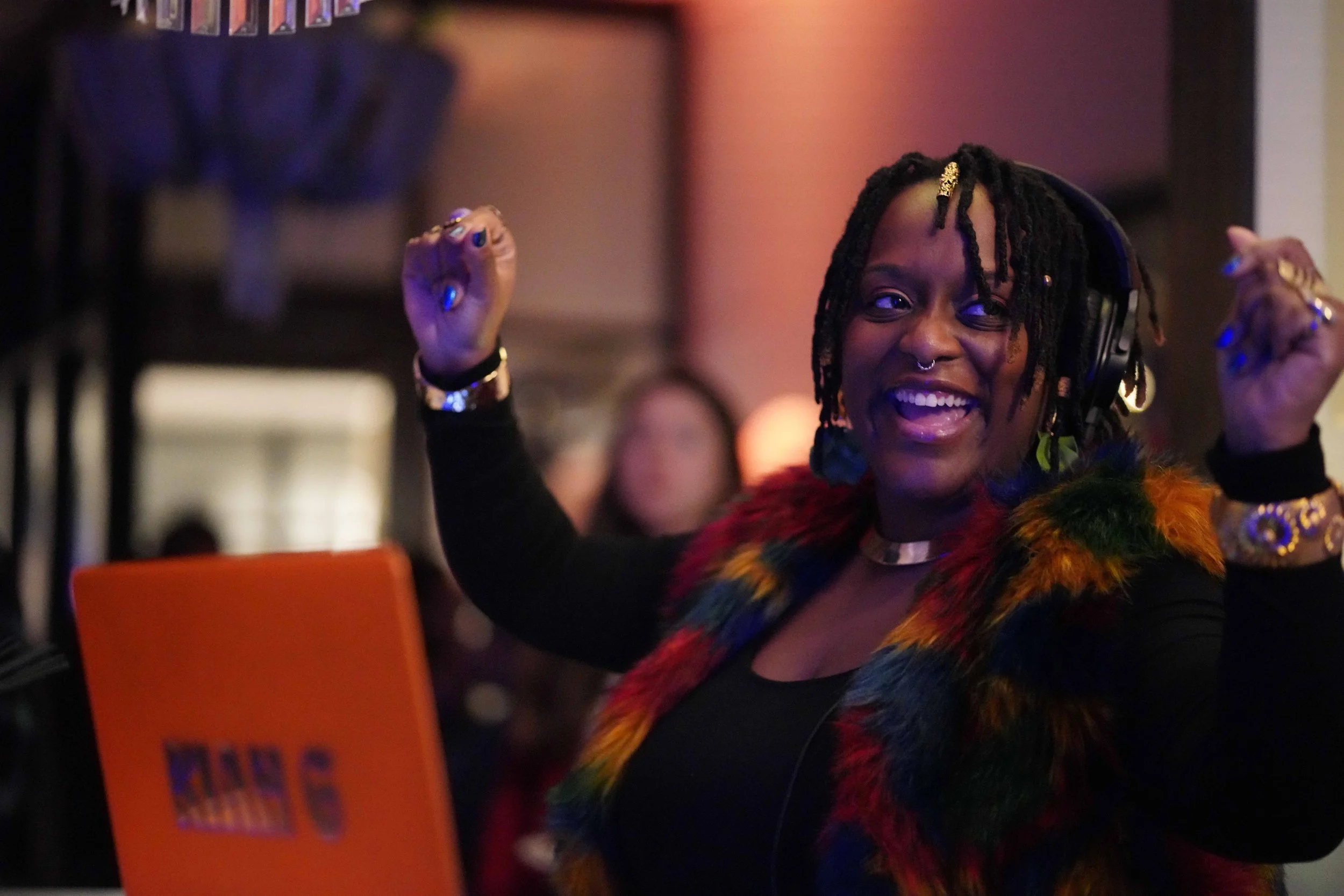
3 evening gatherings
Across the weekend, we hosted artists, funders, distributors, technologists, cultural strategists, and community organizers in one shared space — with multiple standing-room-only sessions. In a festival ecosystem that can often feel difficult to penetrate, Solidarity House functioned as a structured yet permeable container: welcoming, intentional, and rooted in relationship.
HOW WE GOT HERE
Coalition Formation
Solidarity House did not begin as an event. It began as a structural question.
Over the past several years, leaders across the independent film ecosystem have been navigating increasing consolidation, shrinking funding pools, institutional retrenchment, and heightened competition for limited visibility and capital. Many of us were responding to the same pressures inside our respective organizations — often in isolation.
In that context, a small group of organizational leaders began meeting informally. The intention was not to launch a new brand or create a competing platform. It was to ask a more fundamental question: What happens when we stop asking for permission — and instead build alongside one another?
Those early conversations were exploratory. They focused on shared challenges: sustaining artists, protecting creative risk, ensuring equitable access to opportunity, and maintaining relational trust within a field that often rewards scarcity thinking. Rather than positioning our organizations in competition, we began exploring what coordination and shared infrastructure could look like.
Out of that dialogue, the Sundance Coalition formed — an alignment of organizations willing to experiment with collective presence during the 2026 Sundance Film Festival. The coalition was not established as a new institution, but as a coordinated network committed to mutual amplification, shared stewardship, and values alignment.
Solidarity House emerged as the first tangible expression of that coordination — a live, time-bound activation designed to test whether coalition-driven infrastructure could function effectively inside a high-stakes festival environment. It was both an experiment and proof of concept.
Crowdfunding as Shared Responsibility
From the beginning, we made a deliberate decision: Solidarity House would not be underwritten by a single institution — and it would not be shaped by corporate sponsorship.
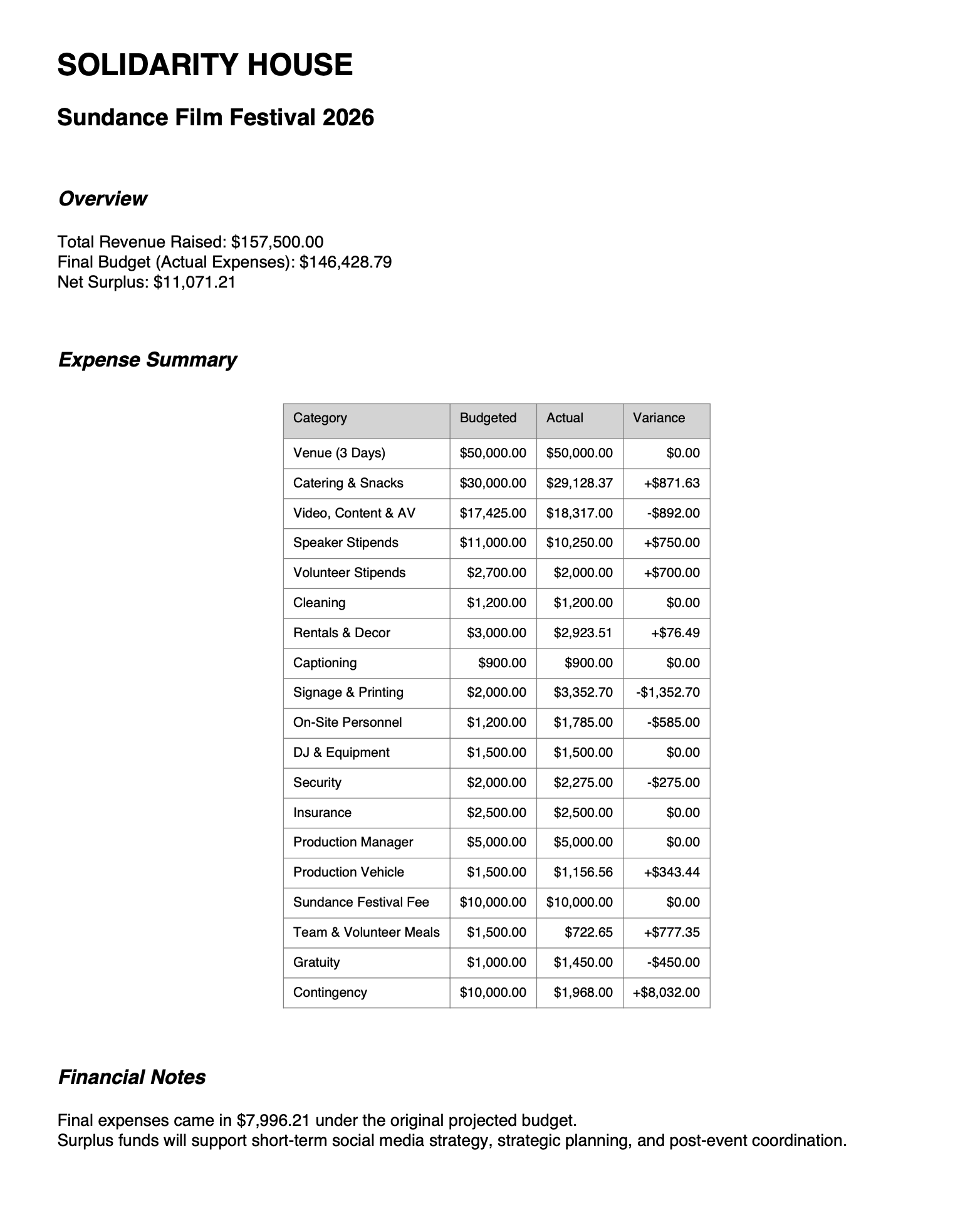
The final budget for Solidarity House totaled $146,428.79. To meet this goal, we introduced a minimum participation threshold of $5,000 for organizations able to contribute financially. Importantly, no organization was turned away for inability to meet that contribution level. Participation was not gated by capital. The threshold functioned as a shared investment marker — not a barrier to entry.
We also made a clear equity commitment: Solidarity House would not accept corporate sponsorship, title placements, or presenting patrons. This decision ensured that no single funder or brand would dominate visibility, influence programming direction, or shape the narrative of the space. By eliminating hierarchical sponsorship tiers and branded prominence, we preserved shared ownership and avoided the optics — and power dynamics — of one entity underwriting the collective.
To create transparency and structure, we established three partnership levels:
Builder Partner — Organizations contributing a minimum of $5,000 alongside operational leadership, co-shaping infrastructure, programming, and coalition governance.
Collaborative Partner — Organizations contributing time, expertise, and network influence through programming, strategy, and amplification.
Amplifier Partner — Funders and institutions contributing $5,000 (monetary or equivalent in-kind value) to expand visibility and resource exchange without engaging in operational leadership.
Each level reflected a shared belief that collaboration can be resourced through funding, labor, amplification, or strategic alignment — and that all forms of contribution hold value.
Together, we successfully crowdfunded $157,500, fully covering the final budget and generating modest surplus capacity to support documentation and post-festival coordination. This funding made it possible to secure venue space, provide production and technical support, ensure accessibility measures, document conversations, host community gatherings, and sustain coordination and operations.
It was not one institution underwriting the work.
It was many institutions practicing shared responsibility.
Financial Transparency & Next Steps
In the spirit of transparency, we are making Solidarity House financials available for public review. As a coalition rooted in shared responsibility and equity, we believe financial visibility strengthens trust and collective accountability.
At a high level, funds were allocated across:
Venue + production
Staffing + coordination
Accessibility + hospitality
Documentation + post-production
Administrative + compliance support
What mattered most was not only how funds were spent — but how they were raised: collaboratively.
Because we collectively raised $157,500 against a final budget of $146,428.79, the Builder Group has voted to responsibly allocate the remaining funds toward sustaining the momentum of Solidarity House. These funds will support a short-term social media contract with LaFuse Entertainment to maintain our online presence over the coming months, as well as strategic planning and listening activities to help us evaluate what Solidarity House can become in its next iteration.
You can view the detailed budget breakdown below.
WHAT WE LEARNED
We’re Still Learning
Solidarity House was designed as a live experiment — a time-bound activation to test whether coalition-driven infrastructure could function inside a high-stakes festival environment. While many questions remain, several clear patterns and structural insights emerged.
Introducing the Pillars
Through programming, coalition dialogue, and partner intake data, four early pillars began to crystallize:
Shared Infrastructure: The field is hungry for aligned spaces that reduce duplication and increase collective power. Solidarity House demonstrated that coordination — rather than competition — unlocks scale. Our partner intake survey revealed that participating organizations collectively serve an estimated 11,000+ artists annually (a conservative midpoint estimate, excluding non-direct service and “unsure” responses).
Key takeaway: Solidarity House is not an aspirational network. It is a coordination point for an existing ecosystem already sustaining thousands of artists each year.
Relational Capital Matters: Trust-building is not a byproduct of the work — it is the work. Across sessions and coalition meetings, leaders consistently named the importance of relationship continuity, transparency, and shared risk.Survey responses reflected that solidarity is already practiced across organizations through shared resources, collaborative models, cross-identity coalition-building, identity-specific programming, and systems-level advocacy.
Key takeaway: Participating organizations understand solidarity as infrastructure — grounded in reciprocity, long-term stewardship, and collective accountability.
Access Must Be Designed: Accessibility does not happen accidentally inside legacy systems. It must be structured intentionally. Our coalition partners contribute across the full creative lifecycle — from talent development and funding to distribution, exhibition, and audience engagement. The most common contributions across partners include:
Audience engagement and community-building
Artist and talent development
Funding and financial support
Distribution and marketing
Production support and exhibition platforms
Key takeaway: The Solidarity House coalition already functions as a complete ecosystem, not a single-stage intervention. Designing access means coordinating these touchpoints more intentionally.
Coalition Requires Governance: Energy is powerful. Structure sustains it. While enthusiasm and alignment were high, it became clear that continued collaboration will require defined governance, decision-making frameworks, and clarity around resource allocation. Partners expressed strong interest in strengthening connections to philanthropic collaboratives, industry guilds, international alliances, festivals, grassroots networks, and global distribution partners.
Key takeaway: The growth energy within the coalition is oriented toward power-building and sustainability — not just visibility. Long-term impact will require strategic coordination, not only convening.
An Honest Assessment & What Comes Next
These pillars are early. They are evolving. What Solidarity House confirmed is that the infrastructure already exists — across organizations, across geographies, and across identities. The opportunity ahead is not to invent a new field, but to coordinate and strengthen the one already in motion.
Solidarity House is not yet a fixed model. It was designed as a time-bound activation, and we are intentionally resisting the urge to prematurely institutionalize it. Instead, we are actively listening.
Key questions guiding the next phase include:
What governance structure best serves this coalition?
Which commitments need to deepen, and which should remain flexible?
What should scale — and what should stay intimate?
What does long-term sustainability look like across funding, leadership, and coordination?
We have more questions than answers — and that feels appropriate.
Rather than moving at the speed of urgency or replication, the Builder Group has chosen to pause, evaluate, and refuel. The next iteration of Solidarity House will be informed by data, partner feedback, strategic planning, and deliberate governance design.
HOW YOU CAN GET INVOLVED
Solidarity House was never meant to be passive.
Here’s how you can stay engaged:
Watch, Share & Engage: All panels and conversations are available to watch and share. Bring these ideas into your communities.
Share Your Favorite Moments: Post clips, reflections, or photos from Solidarity House on social media.Tag the coalition. Tag your collaborators. Extend the dialogue.
Take the Post-Event Survey: Tell us how the experience shaped you. Did it shift how you think about collaboration, care, or coalition work? Your feedback will directly inform what comes next.
Solidarity is not a brand. It is a practice.
What we built in Sundance was proof of concept — that another way of gathering is possible. That coalition is not naïve. That care can coexist with ambition.
Thank you for showing up.
We do not yet know exactly what Solidarity House will become.
But we know this: We belong to each other.